
In this article
A practical guide for industrial network selection.
- Industrial Ethernet fundamentals
- Managed versus unmanaged switches
- Applications across industrial environments
- How to select a suitable model
Overview of industrial Ethernet networking
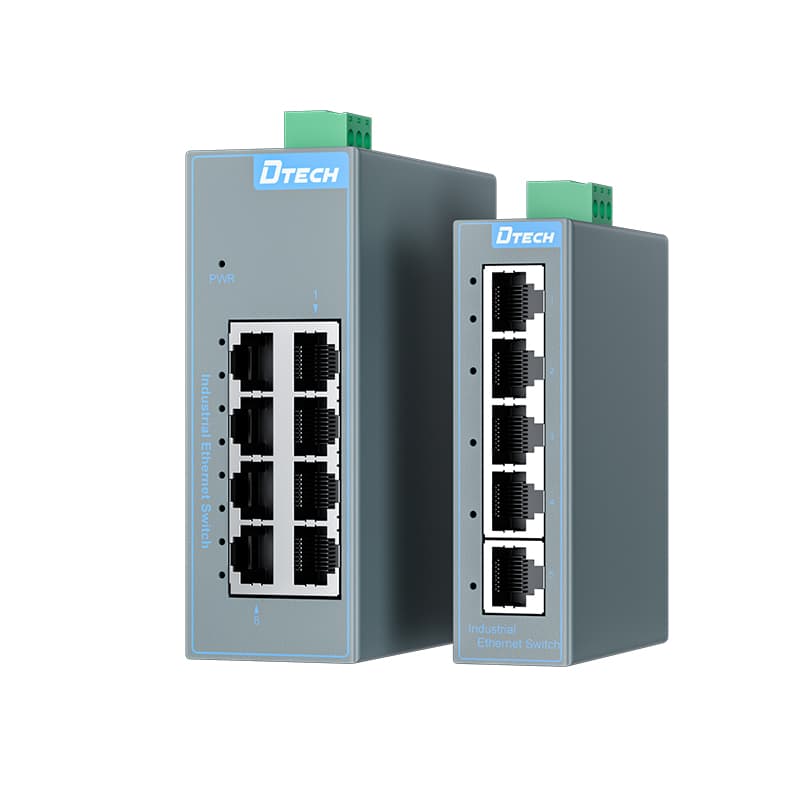
Modern industrial systems require stable communication between PLCs, HMIs, sensors, cameras and industrial computers. Industrial Ethernet switches provide the network layer that links these devices across control cabinets, production equipment and supervisory systems.
Start with the application: devices to connect, required ports, environment, power input and network management requirements.
What is an industrial Ethernet switch?
An industrial Ethernet switch is a networking device specified for industrial installation and continuous system communication. Unlike a general office switch, the model selection normally considers installation, operating conditions, power input and industrial network requirements.
Typical connected equipment includes:
- PLC controllers and remote I/O
- Industrial PCs and HMIs
- IP cameras and edge devices
- Sensors, gateways and SCADA systems
Industrial Ethernet switch types
The appropriate switch depends on the required network function. The main categories below are a useful starting point; confirm specific features against the selected model datasheet.
| Feature | Unmanaged switch | Managed switch | PoE switch |
|---|---|---|---|
| Configuration | Plug and play | Web / CLI management | Data and power capability |
| Network controls | Basic connectivity | VLAN, QoS, monitoring* | Varies by model* |
| Typical use | Simple machine networks | Factory automation networks | IP camera and IoT deployments |
Industrial Ethernet switch applications
Industrial networks are deployed wherever field devices and control systems need dependable data exchange.
Factory automation
Connect PLCs, robots, sensors and production equipment.
Energy & utilities
Support communication infrastructure for distributed monitoring.
Transportation & security
Build robust network links for monitoring and control systems.
How to choose the right industrial Ethernet switch
1. Managed or unmanaged
Choose unmanaged models for straightforward device connections. Consider managed models when your network requires configuration, monitoring, segmentation or redundancy functions.
2. Operating environment
Review expected temperature, vibration, electromagnetic interference, installation method and available DC power input.
3. Port count and network expansion
| Application | Initial selection question |
|---|---|
| Machine automation | How many PLC, HMI and field connections are required? |
| Production line network | Is network segmentation or redundancy required? |
| Distributed industrial system | Are fiber, PoE or remote management requirements involved? |
Related DTECH products
Explore industrial networking products.
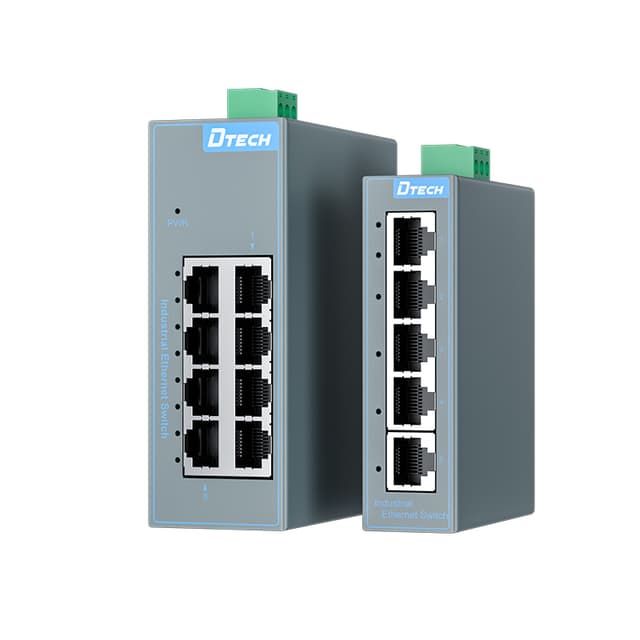 SW1000 / SW2000 Industrial Ethernet SwitchesDiscuss ports, power input, operating environment and installation requirements with DTECH.View switch details
 Industrial serial communication solutions
Industrial Ethernet is often one part of a broader connectivity system. Serial device servers and RS232, RS422 or RS485 converters help connect legacy equipment to modern data networks.
Explore industrial connectivity productsFAQ
Frequently asked questions
What is an industrial Ethernet switch?
An industrial Ethernet switch is designed to provide reliable network communication in industrial environments, including control cabinets, factories, energy systems and transportation applications.
What is the difference between managed and unmanaged switches?
Managed switches support network functions such as VLAN, QoS, monitoring and redundancy. Unmanaged switches provide straightforward plug-and-play Ethernet connectivity.
Why use an industrial switch instead of a commercial switch?
Industrial models are selected for industrial operating conditions. Confirm the required temperature range, power input, installation method and model-level protection specifications before final selection.
Can industrial switches support PLC communication?
Yes. Industrial Ethernet switches are commonly used to connect PLCs, HMIs, industrial PCs, SCADA systems and other automation equipment.
Does DTECH support OEM and ODM projects?
DTECH supports OEM and ODM discussions for applicable industrial connectivity projects. Share your required model, quantity and project requirements with the team.

About DTECH
DTECH provides industrial Ethernet, serial communication and connectivity products for global industrial customers, system integrators and distributors.