
Overview
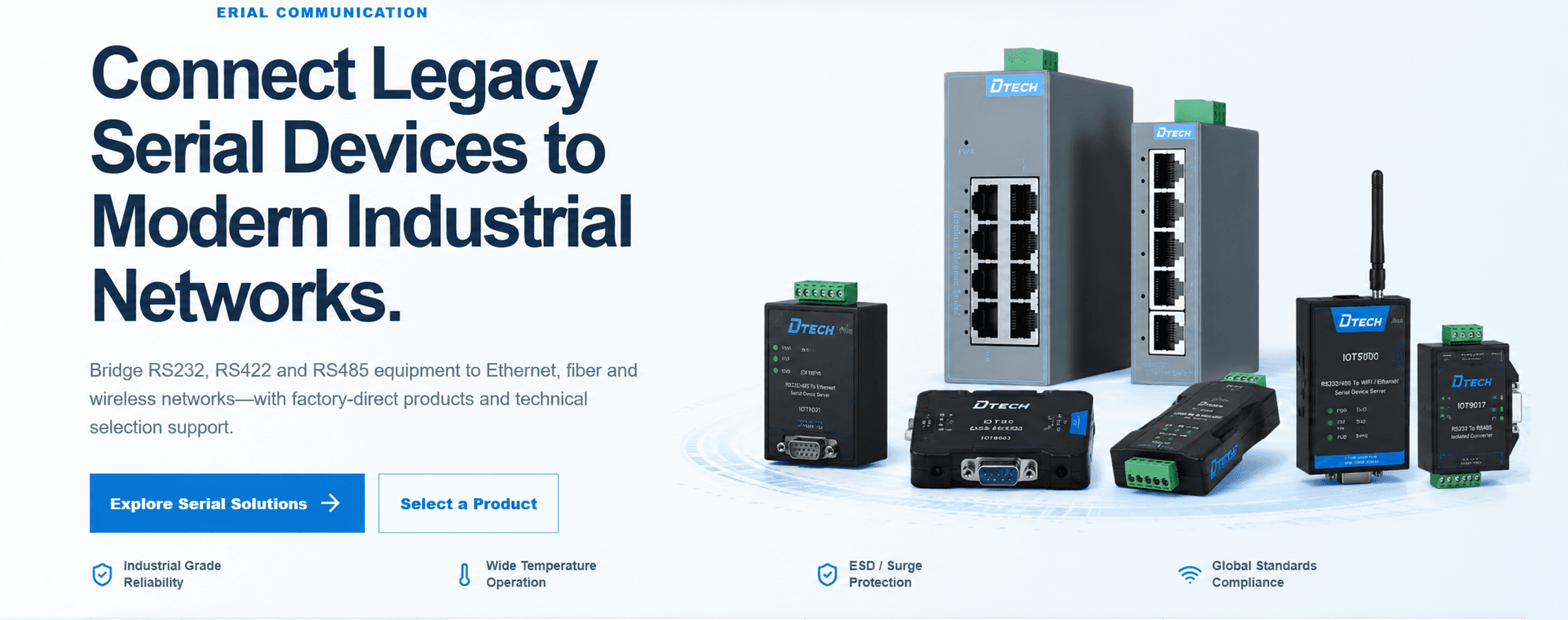
Connect legacy industrial equipment to modern Ethernet networks.
Manufacturing plants, utility facilities, transportation systems and critical infrastructure are becoming increasingly connected. Yet many production assets still communicate through RS232, RS485, RS422 or CAN Bus interfaces that predate modern Industrial Ethernet and IIoT platforms.
An Industrial Device Networking Solution combines industrial communication hardware, network infrastructure, protocol conversion and centralized management into one architecture. It extends the useful life of existing assets while creating a practical path to Industry 4.0.
How can different devices and protocols coexist on a reliable network without replacing thousands of working legacy assets?
Why industrial device networking matters
Operational data often remains isolated inside individual devices without a reliable communication network. Connecting the field layer enables centralized data collection, real-time production monitoring, remote equipment management and integration with supervisory platforms.
- PLC operating status and CNC machine parameters
- Temperature, humidity, flow and electricity meter data
- Industrial camera, AGV and AI inspection data
- SCADA, MES, ERP and industrial cloud connections
Five-layer architecture
How a modern industrial networking architecture works
Successful projects are layered systems rather than single products. Each layer has a clear responsibility and together they form an IIoT communication infrastructure.
The biggest challenges in industrial device networking
Legacy serial devices
Production lines often rely on RS232, RS485 or RS422 equipment that cannot communicate directly with Ethernet-based management systems. Serial device servers and protocol converters provide a migration path without unnecessary equipment replacement.
Multiple communication protocols
Projects may combine Modbus RTU, Modbus TCP, CAN Bus, proprietary serial protocols and Ethernet-based systems. A successful architecture must plan interface conversion and interoperability from the beginning.
Harsh environments and long distances
Vibration, dust, humidity, electrical noise and temperature changes influence product selection. Fiber networking is valuable where distance, electromagnetic interference or backbone bandwidth becomes a constraint.
Core technologies for the communication layer
Serial device servers
Bridge serial equipment to Ethernet for PLC remote access, instrument networking, meter data collection and building automation.
Protocol & interface conversion
Connect different device interfaces while preserving the intended communication path.
Industrial Ethernet & fiber
Build the network backbone with switches, media conversion and fiber links selected for the deployment environment.
Typical selection inputs
| Requirement | Selection question |
|---|---|
| Interface | RS232, RS485, RS422, USB, CAN Bus or Ethernet? |
| Protocol | Modbus RTU, Modbus TCP or another device-specific protocol? |
| Distance & topology | Local copper connection, distributed field link or fiber backbone? |
| Environment | Cabinet, factory floor, outdoor, vibration or EMC exposure? |
Industry-specific industrial networking solutions
Smart manufacturing
Typical requirements include PLC networking, CNC communication, MES integration, AI inspection and robot coordination. Serial device servers, industrial switches, fiber products and PoE networking can be combined around the application.
Water treatment and utilities
Flow meters, water-quality sensors, pump controllers and PLC systems often benefit from RS485 device servers, protocol converters and long-distance fiber connections for centralized monitoring.
Smart power grid and transportation
Smart meters, protection relays, RTUs, traffic signal control, tunnel monitoring and highway surveillance all require architecture choices around reliability, distance, redundancy and real-time monitoring.
Engineering best practices for deployment
- Design for expansion: reserve switch ports, fiber links, cabinet space and address capacity for future devices.
- Separate critical traffic: use appropriate network segmentation for control, video and office traffic.
- Implement redundancy where required: consider ring networks, dual uplinks and backup fiber paths.
- Use industrial-grade components: match the product to temperature, power, installation and EMC requirements.
- Standardize protocols when possible: simplify maintenance through planned interface and protocol choices.
Why choose DTECH as your networking partner
Industrial networking projects involve compatibility across interfaces, protocols, topology and future scalability. DTECH provides a portfolio that spans serial communication, industrial Ethernet, fiber connectivity and product customization discussions for OEMs, system integrators and industrial customers.
Related product families
Build the solution from compatible connectivity products.
 Industrial serial, Ethernet and networking productsStart your selection with interfaces, protocols, distance and deployment conditions.Explore products
 FAQ
Frequently asked questions
What is an Industrial Device Networking Solution?
It is a communication architecture that connects industrial equipment using serial, Ethernet, fiber-optic and fieldbus technologies for centralized monitoring and Industrial IoT integration.
Why are serial device servers still important?
Many industrial machines continue to use RS232, RS485 or RS422 interfaces. Serial device servers let these legacy devices communicate over Ethernet without replacing the equipment.
When should fiber optic communication be used?
Consider fiber where copper Ethernet distance is insufficient, electromagnetic interference is severe, or a high-bandwidth backbone is required.
Can legacy PLCs be connected to Industrial Ethernet?
Yes. Serial device servers and protocol converters can help connect older PLCs to Ethernet-based SCADA, MES and IIoT systems.
How do I choose the right networking solution?
Start with the communication interface, protocol, transmission distance, installation environment, bandwidth, redundancy and future expansion requirements.
Does DTECH support OEM and ODM projects?
DTECH supports industrial communication OEM and ODM discussions, including applicable hardware, firmware, branding and packaging requirements.
Build your industrial network with DTECH
A stable and scalable networking architecture is the foundation of industrial digital transformation. Whether you are connecting legacy serial devices, expanding an Ethernet network, deploying fiber infrastructure or building an intelligent monitoring system, start with a complete understanding of the communication path.
Discuss your industrial networking project